
Skip to content

Excel Functions

Excel f(x)s = Excel Functions

  • CONVERT function CONVERT
  • CHOOSE – tree of decisions CHOOSE
  • Calculate hours between two cells ABS
  • UDF – Convert Number into text (English and Arabic) User-Defined f(x)s = UDF
  • State Abbr with Index+Match+Validation Data Validation
  • Walking Columns ActiveX controls
  • LastSunday, LastSaturday Date and Time
  • Links between two workbooks – dynamically using functions INDIRECT

Excel sessions – 2013 VS 2010

Posted on June 9, 2017 By ANmar

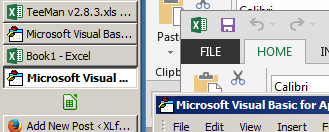
Excel 2010 was great because you can easily open another Excel session while your current session is working.

This allowed us to run multiple tools at the same time, since those two sessions are separated and do not touch.

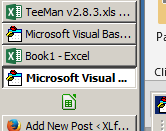
However, starting Excel  2013, the interface changed, making it harder to run new session or open Excel while we have another Excel session running some long process.

that is when we start to look around and found a solution

you can FORCE Excel to open another separated session by running command line in run

Excel -X

This way, you can have two separated Excel sessions that do not affect each other, and we can now run several instances of our long macros.


Excel User tips, Non-functions Tags:Excel2010, Excel2013, Non-Functions

Post navigation

Previous Post: Count how many times letter found
Next Post: OFFSET+MATCH

Related Posts

  • Blank (isempty) VS “” (null string) Excel User tips
  • Shapes with dynamic output Excel User tips
  • Edit directly in cell Excel User tips
  • When Excel tells you to go get some life Excel User tips
  • Skills Grid Conditional Formatting
  • Highlight dates dynamically AND

Recent Posts

  • Calculate above and below me
  • Stale values (Scratched functions)
  • Middle name + 1st name
  • LastSunday, LastSaturday
  • Paste Special Percentage

Archives

Categories

  • Array formula (1)
  • Formulas – combined functions (58)
  • Google Sheets (2)
  • Non-functions (36)
    • ActiveX controls (2)
    • Conditional Formatting (7)
    • Data Validation (7)
    • Excel User tips (19)
    • Format Cells (6)
    • Graphics (4)
    • Names (3)
  • Standard functions (83)
    • Basic Math (18)
    • Date and Time (16)
      • DATE (9)
      • Hour (1)
      • MONTH (7)
      • NETWORKDAYS (2)
      • TODAY (7)
      • WEEKDAY (8)
      • WEEKNUM (1)
      • YEAR (8)
    • Engineering (1)
      • CONVERT (1)
    • Information (6)
      • CELL (4)
      • ISERROR (1)
      • N (1)
    • Logical (31)
      • AND (5)
      • IF (25)
      • IFERROR (7)
      • IFNA (1)
      • IFS (1)
      • ISERROR (1)
      • OR (2)
    • Lookup and References (36)
      • ADDRESS (4)
      • CHOOSE (3)
      • COLUMN (7)
      • FORMULATEXT (1)
      • HLOOKUP (1)
      • HYPERLINK (2)
      • INDEX (5)
      • INDIRECT (6)
      • MATCH (12)
      • OFFSET (15)
      • ROW (11)
      • VLOOKUP (5)
    • Math and Trig (24)
      • ABS (1)
      • CEILING (1)
      • COUNT (1)
      • COUNTA (4)
      • INT (9)
      • LARGE (2)
      • MAX (1)
      • Min (2)
      • SMALL (3)
      • SUM (3)
      • SUMIF (1)
      • SUMIFS (2)
      • SUMPRODUCT (1)
    • Statistical (6)
      • Average (1)
      • COUNTIF (4)
      • COUNTIFS (1)
    • Texts and Strings (24)
      • CHAR (5)
      • CONCATINATE (1)
      • FIND (1)
      • LEFT (8)
      • Len (4)
      • MID (9)
      • REPT (3)
      • RIGHT (2)
      • SEARCH (9)
      • STRING (1)
      • SUBSTITUTE (2)
      • TEXT (4)
      • TRIM (2)
      • VALUE (2)
  • Uncategorized (2)
  • User-Defined f(x)s = UDF (3)
    • HyperlinkOf (1)
  • Worksheet (16)
  • XLfxs (2)

Meta

  • Log in
  • Entries feed
  • Comments feed
  • WordPress.org
  • Excel ad from early 90s Non-functions
  • Change Calculator – calculate change in multiple bills/coins Formulas - combined functions
  • MATCH fumction, just a simple search Lookup and References
  • Paste Special Percentage Excel User tips
  • Excel @ before function names in formulas Excel User tips
  • Custom fiscal year calendar (CFlex) Basic Math
  • Edit directly in cell Excel User tips
  • UDF – Convert Number into text (English and Arabic) User-Defined f(x)s = UDF

Copyright © 2026 Excel Functions.

Powered by PressBook News Dark theme